
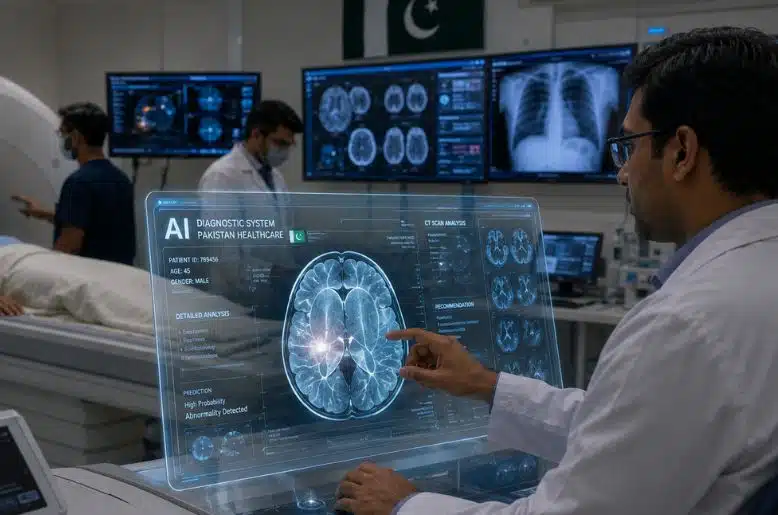
The Pakistani government is bringing modern technology to healthcare. It plans to introduce an artificial intelligence (AI) powered diagnostic system in 1,110 public and private hospitals across the country under the Prime Minister’s Health Card Programme.
This smart system will help doctors detect diseases faster and more accurately. It is expected to benefit nearly 200 million Pakistanis, especially for complex conditions like cancer and neurological disorders. Officials say the AI tool can also lower diagnostic costs and save the government billions of rupees every year.
An agreement with China’s Alibaba Group is likely to be signed next month to make this project possible. Prime Minister Shehbaz Sharif has invited the head of Alibaba to visit Pakistan. Alibaba-linked DAMO Academy and Sky47 will help deploy the AI disease screening systems in major cities.
The rollout will cover Islamabad, Punjab, Khyber Pakhtunkhwa, Balochistan, Gilgit-Baltistan, and Azad Jammu and Kashmir. The federal government already spends about Rs10 billion yearly on the Health Card Programme, while provinces like Punjab (Rs60 billion) and Khyber Pakhtunkhwa (over Rs40 billion) also invest heavily.
This initiative aims to reduce pressure on doctors and hospitals, improve efficiency, and bring world-class healthcare closer to ordinary people. By using AI, Pakistan hopes to catch diseases early and provide better treatment to patients in remote areas too.
In a related development, Punjab is also building the Nawaz Sharif Institute of Cancer Treatment and Research Center, which will offer completely free treatment, including for advanced stages of cancer.